Loading...
Perinatal Pig Brain Transcriptomic and Proteomic Atlas
Summary
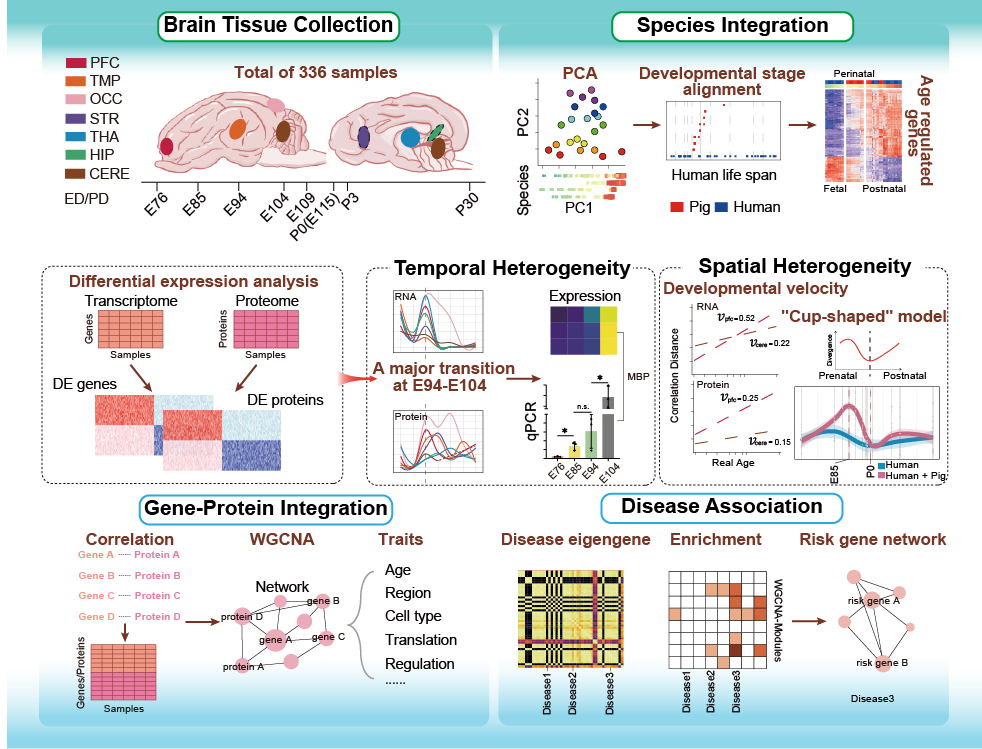
The perinatal period witnesses dynamic structural reorganization and functional specialization essential for establishing later-life neural circuitry integrity. However, molecular mechanisms governing spatiotemporal developmental trajectories during this critical window remain poorly characterized due to limited accessibility of human perinatal specimens. Here, we analysed transcriptomes and proteomes from 336 samples across multiple time points and brain regions in perinatal Bama miniature pigs, showing their spatiotemporal organization and concordance between genes and proteins. We characterized pigs as optimal large-animal model, demonstrating its closer analogy to humans, resemblance to monkeys, and superiority over the mice and other species, while identifying their perinatal stage as a transitional hub bridging early prenatal to postnatal molecular trajectories in humans. We revealed a pan-regional developmental inflection point (E94-E104) during the perinatal period, manifesting as order-of-magnitude changes in the expression of genes and proteins associated with synaptogenesis and gliogenesis. While further analysing developmental velocities across pig brain regions, we discovered regional heterogeneity exhibits a remarkably synchronized rise-and-fall pattern during the perinatal period. Additionally, brain disorder risk genes exhibited a perinatal transition to an adult-like organization in pigs, establishing this multi-omics atlas as a translational framework for decoding neurodevelopmental disorder pathogenesis.
Citation
If you use this data in your research, please cite:
Ziming Wang*, Fan Chu*, Xue Wang* et al. Perinatal brain developmental transition revealed by transcriptomic and proteomic analyses of Bama miniature pigs. Nature Communications (2026). https://doi.org/10.1038/s41467-026-71360-9
Contact
Mingfeng Li (mingfengli@hust.edu.cn); Huazhong University of Science and Technology
Loading...